
- en, kids phones during games
- Cameron
Coaches: End Kids' Phones at Games With One Hour Bucket Rule

The single most effective move is a designated collection system: phones go into a bucket or bag a set time before the game and come back after, with written medical exceptions decided in advance. One Long Island Little League team tried a version of this and had its their most successful season in many decades. For families who still want live scores without a screen, a tool like The Original LiveWire Board fills that gap.
TL;DR:
- Implementing a clear, written phone collection system before games helps establish consistent rules that are accepted as team norms rather than punishments.
- Enforcement methods should be age-appropriate: physical holding for young children, managed buckets for preteens, and honor systems for teenagers to foster trust and compliance.
- Parents can support phone discipline by modeling good habits, preparing kids with snacks and quiet activities, and setting expectations before arriving at the field.
- Medical exceptions are best handled with pre-season documentation rather than ad hoc negotiations, especially for conditions like diabetes or asthma that require continuous monitoring.
- Using alternative activities such as fidget tools or live scoreboards like LiveWire Boards reduces the urge to check phones and enhances engagement without breaking the no-phone rule.
Table of Contents
- A Phone Policy for Kids Phones During Games That Actually Sticks
- What Parents Should Do Before, During, and After Games
- Handling Medical Needs and True Emergencies the Right Way
- Phone-Free Alternatives That Keep Kids Engaged
- How Coaches Can Set Phone Rules Without Losing the Team
- Signs Your Child’s Phone or Gaming Use Might Be a Bigger Problem
- What Phones Are Doing to Play and Friendships at Games
- Legal and Privacy Considerations Parents Should Know
- Teaching Kids to Regulate Their Own Phone Use
- A Coach’s Honest Take on Phone Rules
- A Screen-Free Way to Follow the Score Without Breaking Your Own Rule
- Sources
- FAQ
A Phone Policy for Kids Phones During Games That Actually Sticks
Most phone rules fail for one reason: nobody wrote them down or agreed on the timing before the season started. A rule announced mid game, after a parent gets caught scrolling in the bleachers, feels like punishment. A rule announced at the first team meeting, with a clear time and a clear return point, feels like a team norm.
The bucket system is the simplest version. Phones go into a labeled bin, tote, or literal bucket at a fixed point before warmups, and stay there until the final whistle or the last handshake. That Long Island team took it further, banning phones starting a multi-hour period before first pitch, and players credited the window with sharper focus and tighter bonding once the season wrapped. You don’t need five hours to see a difference. Even a phone-free hour before the game, plus the game itself, changes the tone on the sideline.
Enforcement should scale with age. Here’s a workable breakdown:
- Ages 6 to 9: A parent or coach physically holds the collection bag. Kids this age rarely object; the ritual of “dropping the phone” becomes part of arriving at the field.
- Ages 10 to 13: Introduce a labeled bucket kids manage themselves, with a coach or team parent doing a quick visual check before first pitch.
- Ages 14 and up: Shift to an honor system with spot checks. Teens respond better to a negotiated agreement than a confiscation, and spot checks preserve trust without requiring constant policing.
Youth-sports coaches and mental-performance specialists have found that even brief phone interactions before or during competition can knock out focus for 10 to 30 minutes afterward. That’s the science behind the bucket, not just tradition.
Script language helps at kickoff. Something like: “Phones go in the bucket when we arrive, out when we leave. If your child has a medical device or monitoring need, tell me now so we can set that up before week one.” Framing the collection point as a ritual, rather than a punishment, tends to get faster buy-in from both kids and parents.
Pro Tip: Label the bucket with the team name and put it in the same spot every game. Kids build habits around locations faster than around rules.
What Parents Should Do Before, During, and After Games
Good phone habits at games start well before the car ride to the field. What you do in the twenty minutes before arrival often decides whether the phone becomes an issue at all.
Before the game:
- Charge the phone the night before so a low battery isn’t the excuse for constant checking.
- Confirm pickup logistics and who’s picking up whom, out loud, before you leave the house.
- Pack a snack, water, and one quiet activity so boredom doesn’t become the trigger for reaching for a screen.
- Set the expectation directly: “Phone goes in the bucket at the gate.”
During the game:
- Model the behavior you want. If you’re narrating the game to your phone camera the whole time, don’t expect your kid to respect a no-phone zone.
- Use short, defined check windows for anything genuinely urgent, like a text to confirm a ride, rather than leaving your phone face up the entire game.
- Skip public correction. Pulling a kid aside quietly works better than calling out a phone violation in front of the team.
After the game:
- Debrief briefly. Ask what felt good about the game before asking about the score.
- Praise the moments your child stayed engaged instead of only praising performance.
- Reinforce the family’s normal tech routine once you’re home, so the phone-free window doesn’t feel like an isolated punishment tied only to sports.
Parents’ own phone habits shape what kids consider normal on the sideline. A kid who watches a parent check email every two minutes during a game learns that phones are the default activity for anyone not directly playing.
Handling Medical Needs and True Emergencies the Right Way
A blanket “no phones, no exceptions” rule creates real safety risk for kids managing chronic conditions. Teams enforcing phone-free periods need a plan for medical monitoring before the first practice, not after a confrontation at game three.
Common legitimate exceptions include:
- Type 1 diabetes: Continuous glucose monitor alerts often route through a phone app; the device, not the phone itself, needs to stay accessible.
- Asthma or other respiratory conditions: A phone may be the fastest way to reach a parent if a rescue inhaler isn’t enough.
- Custody or transport logistics: Some kids genuinely need to confirm which parent is picking them up that day.
The fix is documentation, not exceptions negotiated on the fly. A short written note to the coach before the season, or a printed exception card kept with the team binder, does the job. Wording as simple as “My child uses a glucose monitor that alerts through this device; please allow it to remain accessible during games” gives the coach what they need without broadcasting a private medical detail to the whole team. The best practice is to agree in advance on the least intrusive method, such as a watch-based alert, so the exception doesn’t become an open invitation to check texts.
Phone-Free Alternatives That Keep Kids Engaged
Rules land better when there’s something to do instead of scroll. A kid holding a phone-free rule and staring at the grass for two hours will not follow that rule twice.
Age-appropriate substitutes that actually work:
- A small fidget item or stress ball for kids waiting on the bench.
- Simple stick-and-ball games during warmup lulls, if space allows.
- A quiet visualization exercise coaches can lead before the game, walking through plays mentally rather than on a screen.
- A screen-free scoreboard for parents who still want live score tracking without pulling out a phone; LiveWire Boards connects over Wi-Fi and shows instant updates for baseball, football, basketball, and hockey with no app required.
That last option solves a real problem: the parent who isn’t checking social media, just genuinely wants to know how the other game on the schedule is going. Removing the reason to check a phone does more for compliance than any rule ever will.
Brief phone interactions carry a real cognitive cost. Coaches and mental-performance specialists report that a single check can disrupt focus for 10 to 30 minutes afterward, which is most of an inning or a quarter. A kid pulled out of game mode by a notification isn’t just distracted for a second. They’re playing catch up mentally for the rest of the half.
How Coaches Can Set Phone Rules Without Losing the Team
The coach who announces a phone rule cold, mid season, usually gets pushback. The coach who builds it into the season kickoff usually doesn’t.
- Set expectations at the first team meeting. Explain the bucket system, the timing, and why you’re doing it, tying it to focus and bonding rather than discipline.
- Collect medical exceptions in writing before week one. This avoids public disputes later and keeps private health information private.
- Role-play the enforcement language. Practice saying “phone in the bucket, we’re starting” in a neutral tone so it doesn’t sound like a scolding when it happens for real.
- Use graduated discipline, not one-size punishment. A private reminder first, a short bench for a repeat issue, and a parent conversation if it keeps happening. Coaches who follow this escalation model report better compliance and less friction with both kids and parents.
- Fill halftime with something other than screens. A quick team huddle, a stretch circle, or a two-minute strategy talk keeps the phone-free window from feeling empty.
Signs Your Child’s Phone or Gaming Use Might Be a Bigger Problem
A kid who grumbles about giving up a phone for one game is normal. A kid who becomes anxious, irritable, or withdrawn every time a device is out of reach is signaling something different.
Watch for these patterns:
- Noticeable anxiety or irritability specifically tied to not having the phone, not just boredom.
- Pulling away from teammates or skipping team activities to be alone with a device.
- Sneaking phones into the bucket area or lying about handing one over.
Three quick questions to ask yourself privately: Does my child get disproportionately upset over short phone-free windows? Has interest in the actual sport dropped as phone or gaming interest has risen? Is gaming or phone use replacing sleep, homework, or friendships outside of games?
If two or more answers are yes consistently, it’s worth a conversation with a pediatrician rather than another team rule.
Pro Tip: Bring specifics to that conversation, like how many hours per day and how the child reacts to limits, rather than a general worry. It helps a pediatrician point you toward the right next step faster.
What Phones Are Doing to Play and Friendships at Games
A phone in a kid’s hand on the sideline isn’t neutral. It’s competing directly with the physical activity and social interaction the game is supposed to provide.
Kids waiting their turn at bat, sitting on a bench between shifts, or hanging out after a game are exactly the moments where informal social bonding happens: inside jokes, quick strategy chats, the kind of team glue that doesn’t show up on a stat sheet. A phone in hand during those windows pulls a kid out of the group and into a private screen, even when everyone else is sitting three feet away.
There’s also a direct activity trade-off. Time spent scrolling during a water break or bench rotation is time not spent watching the game, cheering for teammates, or picking up on cues that make a kid a better, more aware player. Coaches who’ve run phone-free halftime pilots for a game or two often note that kids re-engage faster with the second half when there’s no screen bridging the gap. It’s a small window, but it’s the window where a kid either stays mentally in the game or checks out of it entirely. Reducing device access during these gaps doesn’t just cut screen time. It restores the social texture that makes team sports worth playing in the first place.
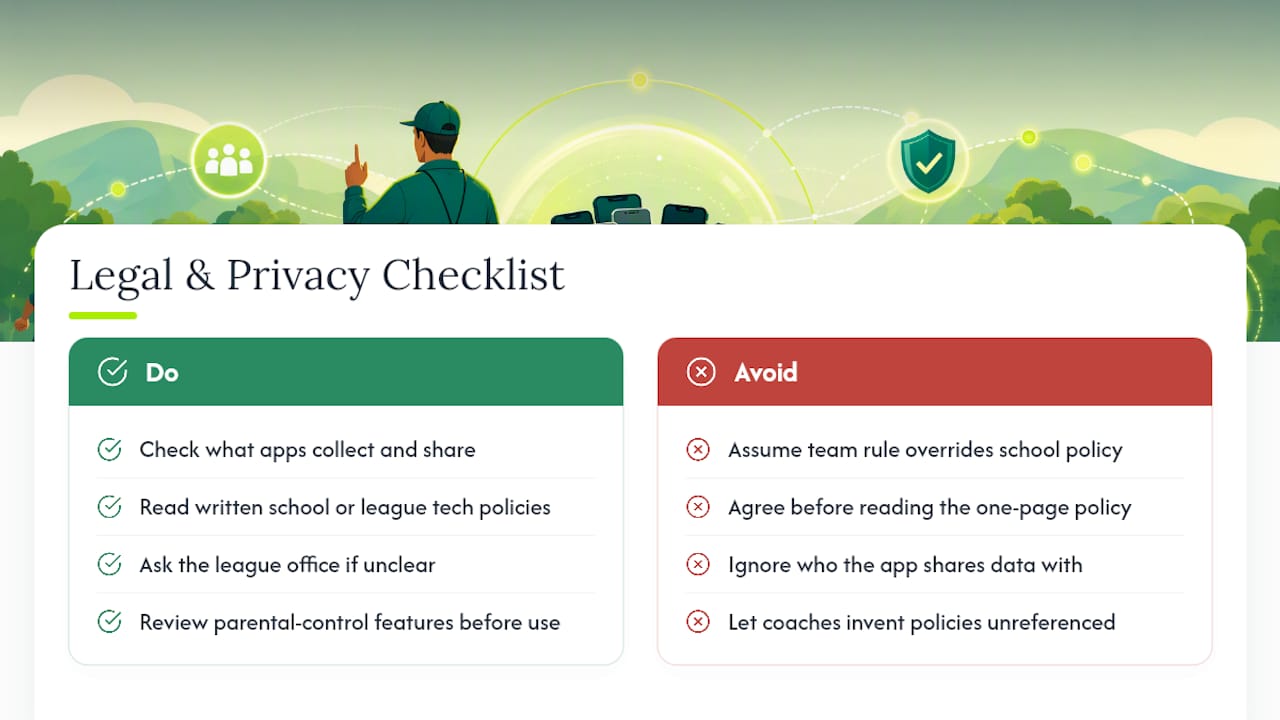
Legal and Privacy Considerations Parents Should Know
Public sports events raise different privacy questions than a living room. Kids’ images end up in the background of other families’ photos and videos constantly, and a phone rule doesn’t change that.
What matters more for privacy is what happens with a child’s own device data. If your child uses a monitoring app tied to a medical device, or a location-sharing feature for pickup coordination, know exactly what that app collects and who can see it before agreeing to a coach’s phone policy. Parental-control platforms vary widely in what they track, and a parental controls overview is a useful starting point before you hand a kid a device to bring to games at all.
School sports programs may also have their own device policies layered on top of team rules, particularly for middle and high school athletics where phones can be used to record other students without consent. If your child’s league or school has a written technology policy, it should take precedence over an informal team rule, and coaches should reference it rather than invent their own from scratch. When in doubt, ask the league office directly rather than assuming a club-level rule covers a school event.
None of this requires a lawyer. It requires reading the one-page policy before signing it, and asking what data a monitoring app actually shares.
Teaching Kids to Regulate Their Own Phone Use
The end goal isn’t a bucket forever. It’s a kid who eventually manages the phone without one.
Start by naming the skill directly: “Putting your phone away without being told is something we’re working on.” Kids respond better to a named skill than a vague expectation. For younger kids, a simple checklist works: phone in the bag when we arrive, out when we leave, no exceptions unless it’s the emergency card. For teens, shift toward a negotiated agreement where they help set the terms, since ownership of the rule tends to produce better follow through than a rule handed down.
Praise the behavior specifically when it happens without prompting. “You put your phone away on your own today” does more long term work than a blanket rule ever will. Decision fatigue is real for kids juggling practice schedules, homework, and social pressure, and building a predictable, low-effort routine around phones removes one more decision they have to make correctly every single day. The same logic behind reducing daily decision fatigue for busy families applies directly here: fewer choices in the moment means better follow through overall.
A Coach’s Honest Take on Phone Rules
Balancing a kid’s need to feel connected with a team’s need for focus isn’t a one-size-fits-all problem, and any coach who claims otherwise hasn’t dealt with a mixed-age roster during a rainy doubleheader… What consistently works is treating the phone rule as a team culture decision, not a punishment handed down from the top. . Adapt the timing, the enforcement style, and the exceptions to your own team. What works for a competitive travel squad won’t fit a rec league of eight-year-olds, and that’s fine.
— Cameron
A Screen-Free Way to Follow the Score Without Breaking Your Own Rule
Parents enforcing a phone-free sideline still want to know how the score is going, and reaching for your own phone to check undercuts the rule you just set for your kid. The Original LiveWire Board solves that specific problem: it connects over Wi-Fi and delivers instant score updates for baseball, football, basketball, and hockey, with no app to download and no extra screen to manage.
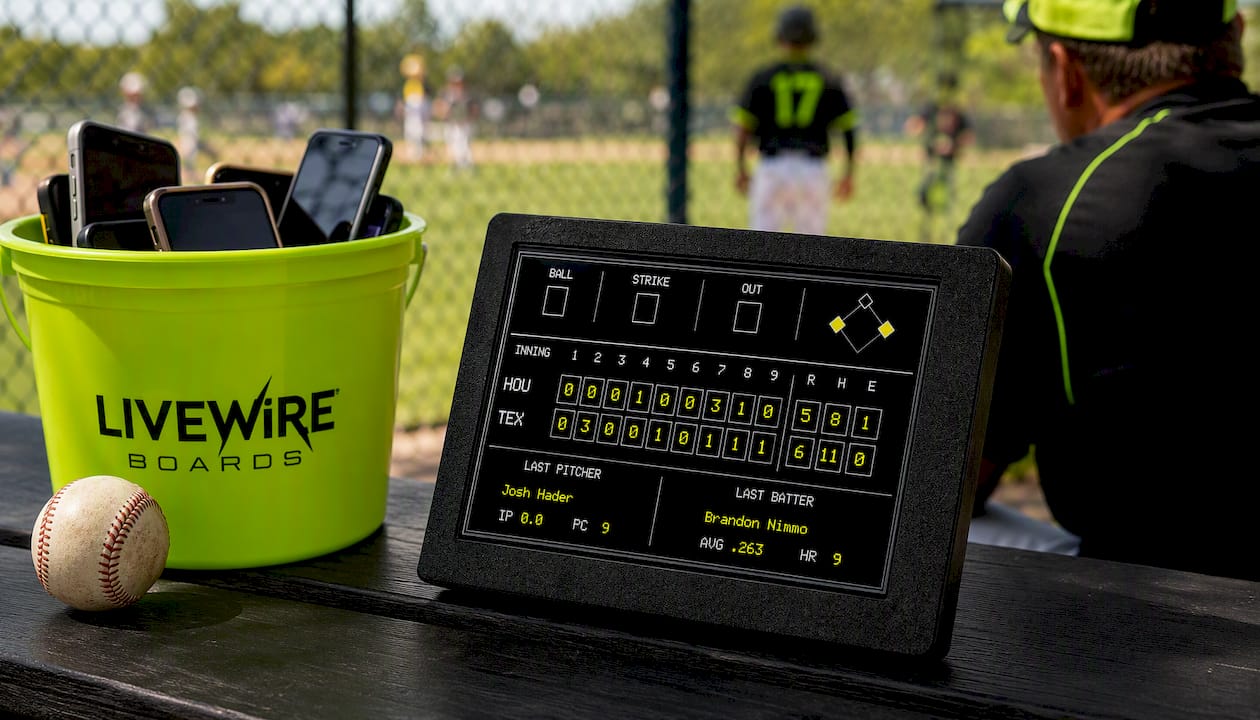
It fits particularly well for families actively cutting sideline screen time, and for parents of kids who benefit from fewer digital distractions competing for attention at home and at the field. Setup takes a few minutes, and once a team is selected, the board runs in the background of any room, no phone required to check it. If you’re building a family routine around less screen time, take a look at the product page and see whether it fits your setup before your next season kicks off.
Sources
- Exclusive | Long Island Little League team has best season in 63 years – and a no phone policy may be the secret
- The 4 Best First Phones for Kids 2026 | Reviews by Wirecutter
- PMC article on medical monitoring and considerations
- Cell Phones at Halftime: Setting Boundaries That Actually Work for Teen Soccer Players - One Beat Soccer
FAQ
What is a good phone for kids to play games on during games?
A basic phone with parental controls, like an iPhone with Family Sharing or an Android device on Family Link, works better than a full-featured smartphone for most families. Kid-focused services such as Pinwheel or Bark, noted in PCMag’s guide, limit distractions while still allowing emergency contact.
What are the signs of game addiction in children?
Watch for anxiety or irritability when the device is unavailable, withdrawal from teammates or friends, and gaming replacing sleep, homework, or in-person activities. If two or more of these show up consistently, a conversation with a pediatrician is a reasonable next step.
Should an 11 year old have a phone, yes or no?
There’s no universal answer; it depends on the child’s independence, whether they walk to practice alone, and family logistics like pickup coordination. Many families introduce a limited, parental-control-equipped phone around this age rather than a full smartphone.
Is seven hours of screen time bad for a 10 year old?
Seven hours a day is well above what most pediatric guidance recommends for that age group, and it likely displaces physical activity, sleep, and in-person social time. If a large chunk of that time is unstructured phone or gaming use, it’s worth reviewing family routines and setting firmer limits around games and practices specifically.
Can a phone-free rule help team bonding, not just focus?
Yes. The Long Island Little League team that adopted a strict no-phone window before games reported both sharper focus and tighter team bonding by season’s end, suggesting the benefit extends beyond just cutting distraction.


